

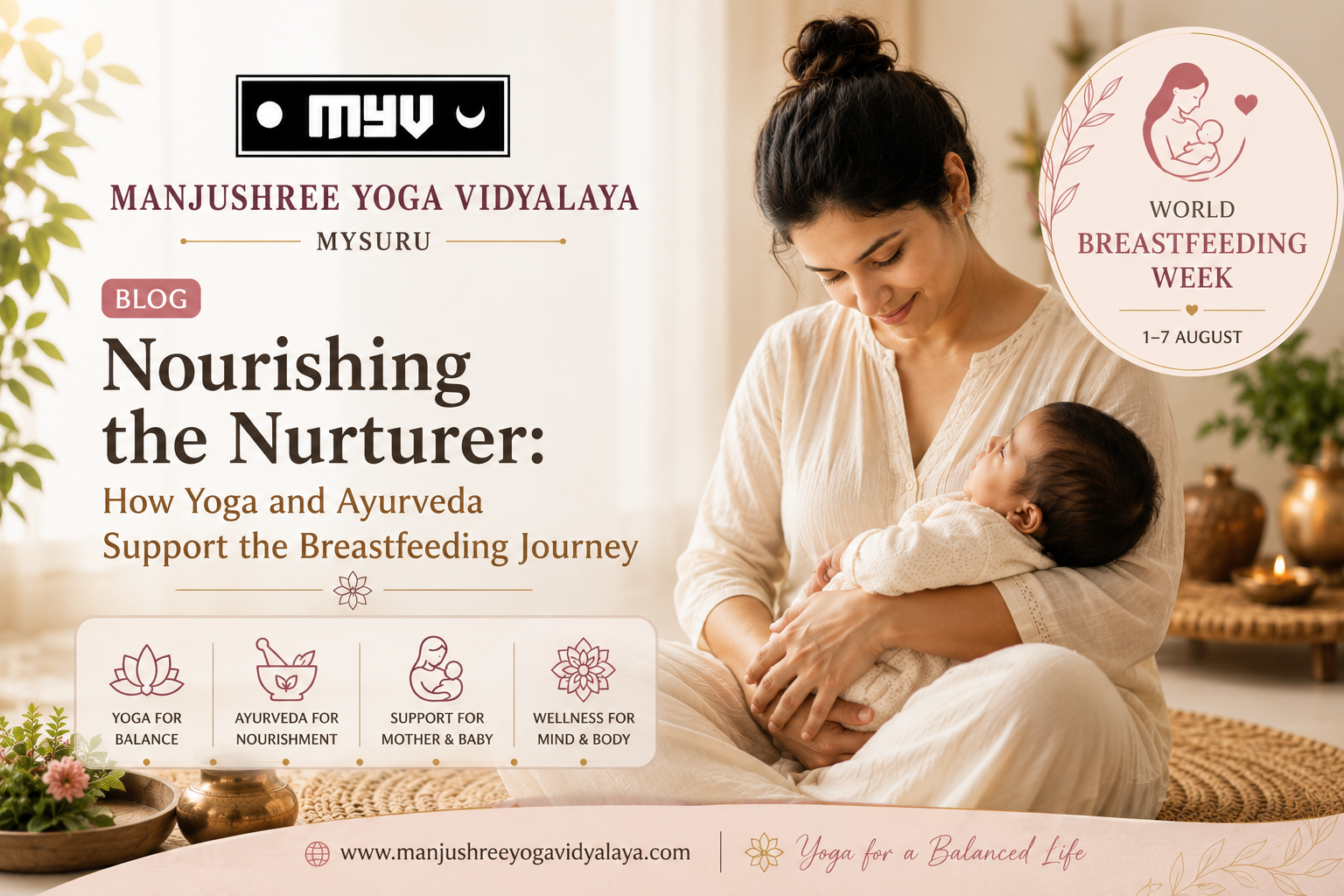
For new mothers, yoga for breastfeeding offers gentle, restorative practices that support milk supply, ease shoulder and neck tension, and bring a sense of calm to the nursing journey — all rooted in the wisdom of Ayurveda.
A Manjushree Yoga Vidyalaya perspective
Breastfeeding is often spoken about only in physical terms — latch, supply, positioning. But in the yogic and Ayurvedic worldview, nursing a child is a far bigger event. It touches the mother’s breath, her digestion, her nervous system, her emotions, and even what the ancient texts call her prana, or life force. When we look at breastfeeding through this wider lens, yoga stops being just a set of stretches, and becomes a complete support system for the mother.
At Manjushree Yoga Vidyalaya, we believe yoga for breastfeeding is not confined to the mat. It is breath, food, rest, mindset, and philosophy working together. This is what we want to explore in this piece — how yoga and Ayurveda, together, can gently support a mother through one of the most demanding and beautiful phases of her life.
A note on how to read this article: Where modern lactation science has studied and confirmed something — like the role of oxytocin in the let-down reflex — we say so directly, with sources. Where a practice comes from the yogic or Ayurvedic tradition and hasn’t been validated by modern clinical research, we describe it as traditional knowledge or yogic science rather than a proven medical claim. Both bodies of knowledge are valuable — they simply operate differently, and a good blog should be honest about which is which.
1. Best Asanas for Breastfeeding Mothers: Poses That Help
Postpartum asana practice should never be about “getting the body back.” In the early weeks and months, the focus is on stability, restoration, and creating space in the body — not intensity. A few asanas that are traditionally considered supportive during the nursing period, once a mother has medical clearance to move:
- Supported Marjaryasana–Bitilasana (Cat–Cow): releases tension that builds up in the upper back and shoulders from hours of holding a baby while nursing.
- Gentle Bhujangasana (Sphinx variation): a mild backbend that opens the chest and counters the forward, rounded posture nursing often creates.
- Setu Bandhasana (supported, with a bolster): opens the chest and hips gently, without straining the abdomen.
- Baddha Konasana (Bound Angle Pose), seated with support: encourages circulation and pelvic ease.
- Viparita Karani (Legs-up-the-Wall): one of the most valuable poses for a new mother — it calms the nervous system, eases swollen feet, and helps with fatigue.
Deep core work, intense twists, and strong inversions are best avoided until the body has fully recovered, and always with guidance from a qualified teacher who understands postpartum anatomy.
2. Pranayama — The Breath That Supports the Feed
If there is one yogic tool with a well-documented physiological effect on breastfeeding, it is pranayama. Modern lactation research confirms that the let-down (milk ejection) reflex is triggered by oxytocin, and that maternal stress and elevated cortisol can suppress oxytocin release and disrupt let-down, while relaxation supports it. This is not a yogic claim; it is established endocrinology.
What yoga adds is a practical toolkit for reaching that relaxed state on demand:
- Deep diaphragmatic breathing before and during a feed is a simple, well-known way to shift the body out of a stress response and towards the calmer, parasympathetic state in which oxytocin flows more easily. [2]
- Nadi Shodhana (Alternate Nostril Breathing), practiced away from the baby, is a traditional yogic technique used to settle an overstimulated nervous system after a broken night of sleep. Its calming effect is widely reported in yoga tradition; large-scale clinical trials specific to postpartum breastfeeding are limited, so we offer it as a supportive practice rather than a proven clinical intervention.
- Bhramari (Humming Bee Breath) is a traditional practice believed to be soothing through its vibration and extended exhale; it can even be tried softly while the baby is at the breast. This is yogic, experiential knowledge rather than clinically studied in a lactation context.
- Simple extended exhalation (making the out-breath longer than the in-breath) is a straightforward, evidence-informed way to down-regulate the nervous system — it needs no equipment, no time, and can be done one-handed.
This is pranayama at its most practical: not a formal seated practice, but breath used as a tool, several times a day, in the middle of ordinary mothering.
3. Ayurveda and Ahara (Diet) — Feeding the One Who Feeds
Ayurveda calls the postpartum period Sutika Kala — a sacred, vulnerable window in which the mother’s body is understood to be rebuilding itself while simultaneously nourishing another life, and therefore in special need of nourishment and rejuvenation. [4]
The Ahara (dietary) principles for this stage, as described in Ayurvedic tradition, generally favour:
- Warm, cooked, easily digestible food over raw or cold food, to support a digestive fire (Agni) considered to be naturally weaker after childbirth. [5]
- Healthy fats, especially ghee, which Ayurvedic texts describe as deeply nourishing for both mother and milk. [6]
- Traditional galactagogue herbs such as fenugreek, shatavari, ashwagandha, and pippali, used in Ayurveda to support lactation, digestion, and Vata balance during this period. [7] These are traditional uses, not clinically established ones — herbs can interact with medications or affect an infant through breast milk, so they should only be introduced under the guidance of a qualified Ayurvedic practitioner or physician.
- Soft, soupy preparations like kitchari and warm porridges in the earliest weeks, gradually building back to fuller meals. [6]
- Avoiding heavy, gas-forming, or very raw foods, which Ayurveda holds can disturb digestion and, through the milk, unsettle the baby too.
The Ayurvedic view is simple: what nourishes the mother’s Agni nourishes her milk. This is a principle from traditional Ayurvedic physiology rather than modern nutritional science, though the underlying logic — a well-fed, well-digesting mother produces better — is broadly consistent with what modern maternal nutrition guidance also recommends.
4. Dosha Balance — Understanding What the Mother’s Body Is Asking For
This is where Ayurveda offers something yoga alone doesn’t: a traditional framework for why a new mother feels the way she does. The dosha system (Vata, Pitta, Kapha) is a construct from Ayurvedic physiology; it has not been validated by modern biomedical science, and we present it here as traditional knowledge, not as a diagnostic system.
Within that framework, childbirth is understood to naturally increase Vata — the dosha of air and space. The body has just emptied a space it held for nine months, fluids and blood have been lost, sleep is broken, and movement (of labour, of constant baby-carrying) is high. Ayurvedic tradition holds that this loss and movement is exactly what aggravates Vata, showing up as anxiety, dryness, gas, constipation, bloating, and disrupted sleep. [8] Many new mothers will recognise this description of “ungrounded, anxious, dry, cold, scattered” even without using the word Vata — Ayurveda’s contribution is a name and a systematic response for it.
Traditional Ayurvedic recommendations for balancing Vata during breastfeeding include:
- Warmth — warm food, warm oil, warm environments
- Routine — regular feeding, eating, and rest times, as far as possible
- Oiling — Abhyanga (warm oil self-massage) is considered in Ayurvedic tradition to be one of the most effective ways to calm Vata, and is also traditionally said to support lactation and sleep. [9] This benefit is described within Ayurvedic texts and practice rather than established through clinical trials, though gentle massage’s general stress-reducing effect is well recognised in mainstream research.
- Stillness — reducing unnecessary stimulation, screens, noise, and travel where possible
As the weeks pass, many mothers move into a Kapha-dominant phase — a natural, grounding energy that supports milk production and bonding, but which, if unsupported, can also tip into heaviness or low motivation. Here, gentle movement, warmth, and light stimulation (rather than the sedentary, cold, or heavy) help keep Kapha balanced without disturbing recovery.
If Pitta is aggravated — showing up as irritability, overheating, or a short fuse — cooling, hydrating foods and a calmer, less demanding routine can help settle it.
The larger point: there is no single “postpartum diet” or “postpartum yoga sequence.” A mother’s needs shift week to week, and dosha awareness gives her — and her teacher — a way to read those shifts.
5. Bhavana — The Mindset Behind the Milk
Bhavana refers to one’s inner attitude, feeling, and mental disposition. In the yogic view, the mind a mother holds while nursing is not separate from the nursing itself.
- Ahimsa (non-harm) turned inward: releasing guilt over supply struggles, missed milestones, or a feeding journey that doesn’t look like someone else’s.
- Santosha (contentment): choosing to find enough in the present moment, rather than measuring against an ideal.
- Non-attachment to outcome (vairagya): doing what is possible with care, and letting go of what isn’t in the mother’s control.
Ayurvedic tradition has long held that a mother’s emotional state during feeding shapes the experience for the baby, and recommends creating soothing environments and maintaining positive thoughts, especially while breastfeeding. [8] This traditional idea lines up well with what modern science has separately established about stress, cortisol, and oxytocin suppressing let-down [1][2][3] — two very different systems of knowledge arriving at a similar practical conclusion, even if only one of them is expressed in the language of clinical evidence.
6. Yoga Nidra
For a mother woken every two to three hours through the night, ordinary rest is often out of reach. Yoga Nidra offers something different: a guided, conscious relaxation practice from the yogic tradition, said to deliver deep restorative benefit in less time than actual sleep would take. Some preliminary studies suggest yoga-based relaxation practices can reduce perceived fatigue and stress, though robust, large-scale clinical research specifically on Yoga Nidra in postpartum or breastfeeding mothers is still limited — so we offer this as a promising traditional practice worth trying, not a clinically proven substitute for sleep.
It requires no strength, no space on the mat, and can even be practiced lying beside the baby. For many new mothers, this becomes the single most sustainable yogic practice of the entire postpartum period.
7. Prana — The Energy Passed Between Two Bodies
Yoga considers prana — life force — as something that moves, transfers, and can be depleted or renewed. This is a concept from yogic philosophy, not a measurable quantity in modern physiology, and we offer it here as a way of thinking rather than a scientific claim. Seen through this lens, breastfeeding becomes an exchange of prana: the mother’s energy, attention, warmth, and nourishment flowing into her child.
This is precisely why replenishing the mother’s own prana isn’t indulgent — it’s structural. A mother who is breathing shallowly, eating poorly, sleeping in fragments, and holding tension is, in yogic terms, running on a diminishing reserve of prana while still being asked to give generously from it. Pranayama, Ahara, oiling, and rest aren’t separate self-care add-ons; in this framework, they are how the mother’s own prana is restored so she has something to give.
8. A Philosophical Note: Seva, Sangha, and Svadhyaya
Yogic philosophy offers three ideas that sit beautifully with the breastfeeding experience:
- Seva (selfless service): reframing the relentless, often invisible labour of nursing not as sacrifice alone, but as an act of service and love — while still honouring the mother’s own needs within it.
- Sangha (community): just as yoga has always been practiced and supported in community, breastfeeding was never meant to be a solitary act. Traditional Ayurvedic postpartum care was built around a circle of women supporting the new mother — and that wisdom holds today.
- Svadhyaya (self-study): the postpartum period, with all its intensity, is also an invitation for a mother to observe herself — her patience, her limits, her strength — without judgment.
In Closing
Breastfeeding, viewed through yoga and Ayurveda, is never just a physical act. It is breath, food, energy, mindset, rest, and philosophy, all moving together through the mother and, through her, to her child. At Manjushree Yoga Vidyalaya, we hope every mother who walks through this phase finds not just poses to practice, but a whole system of support to lean on.
This article is offered for educational and wellness purposes. Please consult your physician, gynaecologist, or a qualified lactation consultant before starting any new physical practice, dietary change, or herbal supplement during the postpartum period.
References
- Aeroflow Breastpumps — Oxytocin and Breastfeeding Let Down: Key Insights
- Legendairy Milk — How Stress Impacts Milk Let-down & How to Fix It
- ClinicalTrials.gov (Tokat Gaziosmanpasa University) — Oxytocin Massage, Milk Let-down Reflex and Breastfeeding Self-Efficacy: A Randomized Controlled Study
- Indian Ayurveda Centers — Ayurvedic Postnatal Care for New Mothers
- Orlando Ayurveda — Ayurvedic Postpartum Tips
- Bodhi Holistic Hub — Ayurvedic Postpartum Care: Nurturing New Mothers the Traditional Way
- Banyan Botanicals — Birthing Ayurveda: Postpartum Part 1 — Nurturing the Mother
- Osh Wellness — Ayurvedic Postpartum Care for New Mothers, Part 1
- Phoebe — The Ayurvedic Approach to Pregnancy & Postpartum
Leave a Reply